Monday, May 5, 2014

A Look at Baroque City Planning with St. Peter's Square as a Case Study


As an Urban and Regional Planning major, I find the layout of cities, and the effect of layout on how people experience the city physically and emotionally, fascinating. European Baroque cities include straight, orderly streets terminating in wide public plazas marked by fountains, majestic views, and obelisks. These patterns differ markedly from the cities characterized by low density and motor vehicles that we are used to seeing in the United States. Baroque city planners knew that people needed to be able to move around easily and efficiently on foot, and this human scale persists (despite some modernization) in cities like Rome and Florence.

The colonnade of St. Peter's Square in Vatican City, designed by Gian Lorenzo Bernini in the 1660s, exemplifies the Baroque city planning ideals of large public spaces with views of important buildings. Indeed, visitors walking through the long boulevard leading up to St. Peter's Square can see St. Peters Basilica from the beginning of the boulevard, and the magnificent building looms ever larger as one approaches. In the Square itself, the colonnade functions as the welcoming arms of the Church embracing the visitor. Bernini designed the Square to broadcast the Lord's and the Church's greatness and authority while simultaneously welcoming the pilgrim into the Church as a valued member.

"To the left and right of the central obelisk on the square are circular marble plates which indicate the foci of the elliptical square. When you stand on either of these plates and look at the nearest colonnade, it will look as if there is only one row of columns instead of four. Bernini wasn't just a great sculptor and architect, he also knew his geometry!" (http://www.aviewoncities.com/rome/ piazzasanpietro.htm).


http://www.vatican.va/various/basiliche/san_pietro/vr_tour/index-en.html offers a 360 degree virtual tour of St. Peter's Square as well as different views inside St. Peter's Basilica. Although these resources cannot entirely capture the experience of being at St. Peter's, they help convey a glimpse of the emotional experience afforded by this brilliantly designed monument.

http://www.theblaze.com/stories/2014/04/20/christ-is-risen-massive-crowd-joins-pope-to-celebrate-easter-sunday-in-st-peters-square/ has pictures and a video clip showing what St. Peter's Square looks like filled with over 100,000 people on Easter,  Christianity’s most joyous day.

Summary of helpful links:

http://www.aviewoncities.com/rome/ piazzasanpietro.htm

http://www.vatican.va/various/basiliche/san_pietro/vr_tour/index-en.html

http://www.theblaze.com/stories/2014/04/20/christ-is-risen-massive-crowd-joins-pope-to-celebrate-easter-sunday-in-st-peters-square/

Leonardo da Vinci: The Original Renaissance Man

Leonardo da Vinci is considered the first "Renaissance man" or "Universal man" because he excelled in a multitude of subjects, including science, mathematics, engineering, inventing, anatomy, painting, sculpting, architecture, botany, music and writing (http://www.leonardoda-vinci.org/). In the present day, scholars are so specialized that it is rare to find a thinker who can excel in both "left-brain" logical and "right-brain" creative disciplines. Da Vinci realized that proportions and mathematical symmetry were necessary to produce aesthetically pleasing works of art like his "Last Supper" and "Mona Lisa" paintings, just like creative, out-of-the-box thinking was required to create his designs for flying machines, which were centuries ahead of his time.

Leonardo's paintings increasingly employed painterly characteristics: "[i]ncreasingly line was replaced by the modulation of colour, and the transitions between figures and landscapes became fluid. Space came to be conveyed not primarily by the use of mathematical perspective, but by lightening the colour and gradually softening the outlines" (Renaissance, Grove Art Online; provided through eCampus). Leonardo lived and worked during the epitome of the high Italian Renaissance at the beginning of the 1500s. His first major sphere of influence was in Northern Italy: he "did not receive the recognition and understanding that were his due in either Florence or Rome. [After] his move to North Italy...close to Venice, he was able both to develop and to spread his influence. The Venetian approach to colour, created by Giorgione and the young Titian, is inconceivable without knowledge of Leonardo" (Renaissance, Grove Art Online; provided through eCampus).

When I studied abroad in Italy, I was able to travel to Vinci, Leonardo's birthplace (Leonardo da Vinci means Leonardo of/from Vinci). I visited the house in which he was born and the museum associated with it. The house contained a virtual, interactive "Last Supper" in which the painting was projected on a large wall and the viewer could zoom in to different parts of the painting by moving his/her hands. It was amazing to see the detailed brush strokes of the painter up close and marvel at Leonardo's precision and skill in painting this important Biblical scene. Below is a picture I took of an exhibit explanation at the museum:


Below you will find photos that I took of the house itself and the surrounding landscape. Leonardo had ample inspiration for his artworks with the beautiful surroundings and close proximity of Vinci to Florence, the center of the cultural world during the Italian Renaissance.


The online resource http://www.leonardoda-vinci.org/ is a helpful site with a biography on Leonardo, pictures of his works, and other information on the great Renaissance thinker.

The article posted at http://economictimes.indiatimes.com/industry/ et-cetera/leonardo-da-vincis-mona-lisa-part-of-first-3d-artwork/articleshow/34639954.cms discusses a fascinating new insight into the Mona Lisa: a supposed "knock-off" of the Mona Lisa may in fact have been painted by Leonardo himself or one of his students. The two paintings, when viewed side-by-side, may compose a "stereoscopic pair", an intentional impression of depth (this would effectively mean that the paintings would have been the first 3D image ever depicted in painting). It seems that Leonardo's genius was even more revolutionary than modern scholars may have thought, and the works of Leonardo may continue to surprise and amaze us as scholars continue to study them in the future.

Summary of Helpful Links:

http://www.leonardoda-vinci.org/

http://economictimes.indiatimes.com/industry/ et-cetera/leonardo-da-vincis-mona-lisa-part-of-first-3d-artwork/articleshow/34639954.cms

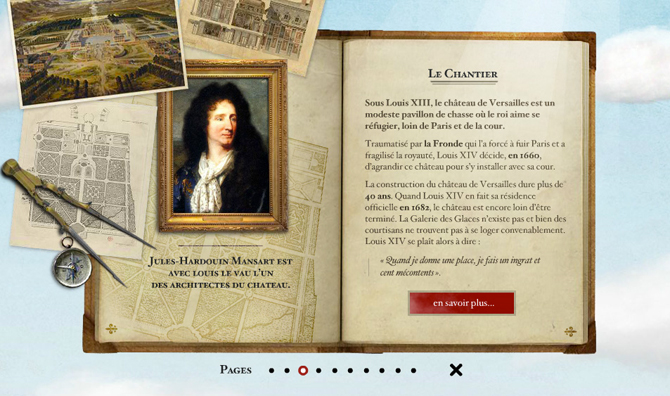
Versailles 3D Review Part 3: Shambles at Versailles Game


Well, the most recent time I tried to play, I got a 404 "Page Not Found" error.  Hopefully that won't happen when you try:
http://www.versailles3d.com/en/the-versailles-3d-projects/shamble-at-versailles.html

In the link won't work for you, you can at least read about it and watch a play-through (albeit in French) and the case study (in English) at this link:
http://www.84paris.com/#/projects/shamble-at-versailles/

Ok, so history is usually a hard sell to kids.  This game seeks to change that.  

As soon as the game starts, we meet Louis the XIV, in talking-painting form.  We quickly meet other talking paintings who guide us through the game.  This is hilariously entertaining, until you find out that the paintings won't stop talking.  A pitfall I feel the game falls into is that it is tries to teach through narration, which is not only about the most boring part of the game, it is pretty much the same as sitting in a classroom.  I want to play the game, I don't want to sit here and listen to fluff talk!  

Perhaps this excess of narration is the reason the average user spends only six minutes playing the game (they mention it in the second link I posted).  While six minutes of learning is certainly better than zero,  considering the average child spends seven hours each day on entertainment media (some of which likely includes video games), Shambles at Versailles could clearly be doing a better job (http://www.aap.org/en-us/advocacy-and-policy/aap-health-initiatives/pages/media-and-children.aspx).  Also, it should be noted that you cannot beat the game in six minutes.  At least, a 22 year old college student cannot even get half-way through the game designed for 8-12 year-olds in six minutes.  Speaking of the target age group, I imagine anyone older than nine or ten getting bored with this really, really quickly.  I think a more appropriate age range might be 6-9 years old and might even be fun for 5 year old children with the help of a grown-up (they will definitely like the talking paintings).         

Although the stages of the "journey" of building digital Versailles parallel the major building campaigns of Versailles, there seems to be very little learning happening in the gameplay itself.  I don't understand how leading a lost Louis XIV through a garden maze is relevant to the history of Versailles other than the very tenuous relationship that both the game and Versailles have garden-mazes and a Louis XIV.    

Another issue I have with the game is that the only lose condition is running out of time.  Even if I have no clue what I am doing, most of the time I can still win the mini-game within the time limit through sheer chance (though, granted, I am well outside the intended age range).  For example, I can randomly click on animals in the menagerie until I figure out where they are supposed to belong (oh wait, I actually did that- even with all that narration, I still had no clue what I was supposed to do).  Similarly, I can randomly click on seed packets and scatter them about the screen with no real method until I fill in the garden, because there is no penalty imposed for planting the wrong seeds in the wrong places.  The irony of losing is that it makes you want to play more, not less.  Case in point: the smash hit "Flappy Bird."  Therefore, by making the game nearly impossible to lose, Shambles at Versailles decreases player interest over time.  On average that interest hits zero at the six minute mark, or about three minutes after the initial bout of narration.         

The final bone I have to pick with Shambles at Versailles is that there is perhaps a little too much verbal encouragement.  When I was in the maze, for example, even if I was heading away from the goal I would get a "Great job!" or "Keep going!" or "You're so smart!"  It actually confused me at first because I thought I was doing something right by heading away from the goal (as I was being rewarded).  After another second or two, I realized the praises seem to be randomized on a timer and bear no connection with your actions in the game.  A good game, however, should be self-motivating.  In other words, you don't have to be told to keep going because you want to keep going, even when (especially when) things get challenging.         

Obviously, there's quite a bit of room for improvement, but there are some praiseworthy elements to Shambles at Versailles.  I really like that, as a reward for completing the game, you can print your own tiny little model pattern of Versailles.  This is how an educational game should work:  fun learning is rewarded more fun learning (emphasis on the fun)!  This way learning becomes rewarding in and of itself, instead of relying on an outside stimulus (like candy or verbal praise) to make learning rewarding.  Evidence shows that printing out a tiny model of Versailles has been massively popular, with nearly 15,000 models printed in the first three months.  I also like that the game makes it easy to learn more with an interactive story book.  For gamer-students who are interested enough to learn more, additional information is literally a click away.  Finally, as I mentioned before, I really like the talking paintings as characters... I just wish they wouldn't talk quite so much. 

It is no easy task to get children excited about history, but who can blame them if their only encounter with history has been through textbooks and lectures?  Shambles at Versailles offer a much needed alternative method of learning, and though it can and should be improved to increase player retention, it is still valuable as a learning tool.          


Here's what other bloggers had to say about the game:
http://marie-antoinettequeenoffrance.blogspot.com/2012/06/shambles-at-versailles.html       

http://historytech.wordpress.com/2012/11/02/tip-of-the-week-shambles-at-the-palace-of-versailles-simulation/


If you would like to brush up on some very basic game theory and learn about the essential components of a game:
http://en.wikibooks.org/wiki/Video_Game_Design/Theory 

Four Ways the Rococo Helped Shape the Look of Tangled


1. Rendering


Left: A Game of Hot Cockels, By: Fragonard
Right: still from Tangled

The rendering technique used for Disney's Tangled attempts to make the movie appear more painterly.  Just as the trees become faint swaths of color as they near the horizon in Fragonard's painting, so the trees abstract from high detail in the still from Tangled.  Both images have a distinct foreground, middle-ground, and background.

For more about the art direction in Tangled, go to: 

2. Environments

File:The Progress of Love - The Meeting - Fragonard 1771-72.jpg


Left: The Progress of Love- The Meeting, By: Fragonard
Right (top): Tangled concept art, By: Lisa Keane
Right (bottom): still render from Tangled

The exact tree from Fragonard's "The Progress of Love" appears in Lisa Kean's concept art, bending over in the background to very nearly touch the roof of the tower.  Although this tree did not make it to the final render, it's iconic curving form did (small tree near the right, bottom corner).  Indeed, true to it's Rococo reference, everything in the final render seems to be curving and bending: the waterfall, the stream, the branches and trees, even the terrain.  

To see the most dramatically Rococo environment I was able to find from Tangled in action, watch:
https://www.youtube.com/watch?v=-mm6yVpuoK8

3. Concept Art

Left: Early Rapunzel Concept, By: Claire Keane
Right: a detail from Duchesse de Polignac, By: Vigee-Lebrun
The porcelain completions, pastel eyes, rosy cheeks, and wavy hair of Rapunzel and the Duchesse de Polignac bear an uncanny resemblance: they could be sisters.  The feathery brush strokes with which the hair in both paintings were rendered are also a note-worthy similarity.  

For more Tangled character concepts and the evolution of Rapunzel, go to:
http://www.cgmeetup.net/home/art/tangled-concept-art-and-character-art/

4.  The Swing

Left: Tangled concept art, By: Lisa Keane
Right: The Swing, By: Fragonard

"The Swing" by Fragonard is the foundation for the art direction of Tangled.  This concept art by Lisa Keane is practically a 1:1 ratio of Fragonard's Swing, with the subject matter toned down to a "G" rating.  For some reason, Disney did not think it would be appropriate to have a man looking up a lady's skirt in their concept art for a children's movie.

For more about the art that inspired movies (and an excerpt on the Swing's influence on Tangled), go to:
http://www.empireonline.com/features/paintings-that-inspired-the-movies/p8

Sunday, May 4, 2014

Schonbrunn Palace, Vienna: Crown of the Habsburg Empire

The Habsburg Empire, seated in Vienna and brought to prominence in the 16th century, sought to display its authority and power through palace complexes, much like Louis XIV of France sought to do with the Chateau de Versailles. Schonbrunn Palace in Vienna is a Baroque masterpiece and monument to the splendor of the Imperial Habsburgs.  

“The Habsburgs derived their right to unlimited dominion from religion; as emperors of the Holy Roman Empire they were firmly convinced of a divine mission in exercising the highest secular office in Christendom. The divine right of kings was firmly anchored in the idea of Empire…The imperial ethos of the Habsburgs, underpinned by religion, was in fact seen as the conscious antithesis to the French kingship of Louis XIV with its flaunting of secular pomp.” –The World of the Habsburgs (http://www.habsburger.net/en). This website offers a virtual exhibit of the rich history of the Habsburg Empire and includes timelines, biographies, maps, and other extensive resources on this family that impacted the course of European history. 

During the Middle Ages, the estate that was to become Schonbrunn was known as the Katterburg – a hunting lodge, much like the origin of Versailles. In 1612, Emperor Matthias came upon a schöne brunnen (“fair spring”) while on a hunting excursion, from which the name “Schonbrunn” was derived.

In 1688, Emperor Leopold I hired Italian-trained architect Johann Bernhard Fischer von Erlach to design a magnificent new residence for son Joseph I, who was known as Austria’s “Sun Emperor” (another reference to Louis XIV and the state’s increasing power). Designs were presented for a new palace, the Schönbrunn I Project.

The floor plans below show the grand layout of one of the floors of the Palace. In the hierarchy of rooms, the most important spaces are toward the middle and the back of the structure (Ceremonial Room, Great Gallery, Hall of Mirrors, etc.). The photos of the Palace interior show a glimpse of the richness, opulence, and taste of this monumental building.


http://drewidhistory.wordpress.com/2011/05/31/european-baroque-architecture/


http://www.schoenbrunn.at/en.html


http://junkboattravels.blogspot.com/2012/05/may-8-schonbrunn-palace-vienna.html


http://junkboattravels.blogspot.com/2012/05/may-8-schonbrunn-palace-vienna.html


The photograph below shows Schonbrunn's Hall of Mirrors, and the photograph after (two photographs down) depicts Versailles's Hall of Mirrors (again highlighting the similarities between the two palaces).


Schonbrunn. http://designergirlee.wordpress.com/page/9/


Versailles. http://www.guidedtoureurope.net/visit-versailles-hall-of-mirrors/
    

The types of garments worn in the Habsburg Court at Schonbrunn were fashions that followed the Baroque style of the French and Italians. Women wore extravagant silk dresses in vibrant colors decorated with laces and ribbons, and a narrow waist was achieved through corsets and emphasized by contrast to wide sleeves and skirts. Furthermore, “flea furs” were worn during winter and were thought to attract fleas to the fur instead of the women’s skin. Men typically wore long jackets, linen shirts, justaucorps (waistcoats), and powdered wigs.


 http://www.vienna-unwrapped.com/baroque-costumes/

This is a link to a YouTube video of a Baroque musical composition by Heinrich Biber (perhaps the forerunner to Justin Bieber). The piece is called Battalia a 10 in D major, C. 61 and is typical of the music that would have been played for the Habsburg Court of the Baroque period. One can listen to this song and imagine what it would be like to hear it reverberating through the magnificently frescoed and decorated halls of Schonbrunn. https://www.youtube.com/watch?v=Z9DJpaxT7wg

Summary of helpful links:

http://www.habsburger.net/en - World of the Habsburgs Website
http://www.vienna-unwrapped.com/baroque-costumes/ - Baroque fashions
https://www.youtube.com/watch?v=Z9DJpaxT7wg - Heinrich Biber Baroque music

5 Paintings that Illustrate Important Motifs and Historical Underpinnings of Mannerism


1. Deposition from the Cross, By: Pontermo
Compared to the renaissance, the Church played an increased role in monitoring and censoring artists, but artists were permitted to maintain their own artistic individuality. The Church sought to emphasize on the “drama” of scenes depicted in the Bible and sought to elicit emotion (especially shock and awe) from viewers. Artists often relied on “theatrical” poses and compositions. For example, there was often a disconnect between specific characters and other parts of the scene, in a similar fashion to an aside. This represents a significant shift from renaissance art, where the clear and deliberate depiction of a story was paramount.
For more about the church, mannerism and the transition from the Renaissance watch this video:
https://www.youtube.com/watch?v=ombPQ6egLE8


2. Venus and Folly, By: Bronzino
Mannerist paintings are usually directed toward connoisseurs rather than the general public, featuring illogical sophistication, coupled with a plethora of references to classicism, mythology, and/or Biblical characters. This deliberate irrationality would confuse the general public, much as it confounds viewers today.

3. Madonna of the Long Neck (aka- Madonna and Child with Angels and St. Jerome), By: Parmigianino
Mannerism tends to be a more realistic style, but one that elongates the scale and shape of the human form. Here we see the neck and fingers of Mary and the body of Christ appear elegantly, but unnaturally long. 


4. Portrait of Cosimo I de'Medici, By: Bronzino
The Medicci family returned to Florence around the time a Medicci pope was elected. The Medicci Family used art, especially art in the Manneristic style to add credibility to their court by showing-off their taste, sophistication, and sense of fashion.

"Around 1543, by which date Cosimo had consolidated his authority in Florence, the need arose for the creation of his official image. In response, Bronzino executed a first portrait of the Duke in armour which would function as a tool of political propaganda both within his own territories and abroad, and from which numerous later versions were produced." (For more about Bronzino and the Medicci, go to: http://www.museothyssen.org/en/thyssen/contenidos_articulo/10)


5. Portrait of a Young Man, By: Bronzino

Mannerist portraits often featured masks. This is likely a reference to the restrictive court etiquette of the time, which encouraged hiding one's emotions and intentions.

For more about masks in Mannerism, and more specifically this painting, watch this video:

Perusing the Internet for an Adequate Definition of Mannerism, Giving up, and Making my own one Instead

I looked at the definition of Mannerism as defined by four respectable dictionaries. Interestingly, there was very little overlap between the definitions. For example, of the two dictionary entries who included names of prominent Mannerist artists, there were exactly zero artists in common.  I found every definition to be lacking in some way, so I eventually decided I should make my own.    


Here's what the dictionaries say (followed by my rating of the definition's effectiveness):

Mannerism (dictionary.com):
( usually initial capital letter ) a style in the fine arts developed principally in Europe during the 16thcentury, chiefly characterized by a complex perspectival system, elongation of forms, strained gestures or poses of figures, and intense, often strident color.

Link: http://dictionary.reference.com/browse/mannerism


Definition rating: good

Issues with this definition: “complex perspectival system” is too vague. In what ways are the perspectival system complex?

Mannerism (Merriam Webster):
often capitalized : an art style in late 16th century Europe characterized by spatial incongruity and excessive elongation of the human figures

Link: http://www.merriam-webster.com/dictionary/mannerism


Definition rating: fair

Issues with this definition: “spatial incongruity” is too vague. “excessive” elongation could imply judgement. Obviously, the elongation of figures did not seem excessive to the artists.

Mannerism (Oxford English Dictionary):
a style of 16th-century Italian art preceding the Baroque, characterized by unusual effects of scale, lighting, and perspective, and the use of bright, often lurid colors. It is particularly associated with the work of Pontormo, Vasari,and the later Michelangelo.

Link: http://www.oxforddictionaries.com/us/definition/american_english/mannerism


Definition rating: fair

Issues with this definition: no mention of iconic elongated curving figures. “Later Michaelangelo” could be made more clear with “the later works of Michelangelo.” It almost sounds like we are talking about a Michelangelo Jr.


Mannerism (Cambridge):
A style of 16th-century Italian art that did not follow traditional rules of painting and tried to represent an image of beauty that was perfect rather than natural: Mannerism is characterized by a distortion of proportions and perspective. Leading Mannerists include Parmigano and Gulio Romano, whose pictures are painted in deep, rich colors.

Link: http://dictionary.cambridge.org/dictionary/british/mannerism_2


Definition rating: bad

Issues with this definition:

 Nearly all art does not follow the “traditional rules” set by the generation of preceding artists. Also what is considered “traditional rules” here?

There is no mention of elongated, curving figures (though hinted at with “distortion of proportions”)


“Distortion” is too vague and has a negative tone. In what ways do have the forms been distorted?  Are they blurry, do they have arms that look like curly fries?  Also, saying a figure is "distorted" is  like saying the artists disfigured the human form, when in fact Mannerist artists sought to perfect the human form (which, ironically, is mentioned in Cambridge's own definition).


Here’s what the four dictionaries did agree on:

1. Happened in 16th century: 4
2. Occurred in Europe: 4
(It should be noted that two of the definitions did so implicitly by defining Mannerism as an Italian movement)
3. Intense color: 3
4. When referring to art, Mannerism is usually capitalized: 2.5
5. Occurred in Italy: 2
6. Elongation of forms: 2


My attempt at a better definition:

Mannerism- A style of art centered around Italy that historians attribute to 16th century Europe, between the renaissance and baroque periods. This style is predominately known for its intensely vivid colors, and elegantly elongated, curving figures, which are often depicted overlapping and/or in overly-dramatic or strained poses. This style is also known for intentionally illogical, though convincing, use of techniques pioneered and refined during the renaissance, such as perspective, lighting, and composition. Also common for Mannerism was its intellectually sophisticated, though inaccessible and at times even incoherent, subject matter which drew from any combination of Christianity, classicism, and mythology.