Thursday, December 5, 2013

Catherine Palace

Francesco Bartolomeo Rastrelli

1752-56

St. Petersburg, Russia


In 1717 Catherine I of Russia wanted to build a summer palace, she contracted German architect, Johann-Friedrich Braunstein. Originally it was a fairly modest two story building. When Empress Elizabeth inherited the palace she decided it was too outdated. She had the palace completely reconstructed by a number of different architects before she finally commissioned Francesco Bartolomeo Rastrelli to demolish the palace and design a grander palace in its place.


The palace finally completed in 1756, and no expense was spared. More than 100 kilograms of gold were used as decoration and gilding for the 325 meter long palace. The facades are decorated with white and pastel blues, similar to the rococo style. The interior is full blown rococo, with golden state rooms and ornate gilded panels. The palace is lined with large arched windows that help to illuminated the various stucco decorations and frescos on the walls and ceiling.


One of the most extravagant interior spaces is the amber room. The entire room is covered with panels of amber mosaic. The original panels were initially a gift for Peter the Great from a Russian craftsman. Unfortunately, the original panels were lost when German troops took over the palace and shipped them off to Konigsberg. In 1982 there was a restoration effort for the amber room, which took over 20 years and $12 million dollars to finally complete.

For more information click the link below for a video tour through the palace.
http://www.youtube.com/watch?v=6BVAhjR6VM4


Sources
http://www.saint-petersburg.com/pushkin/catherine-palace.asp
http://en.wikipedia.org/wiki/Catherine_Palace
class notes

Wednesday, December 4, 2013

Würzburg Residence

In 1719 Johann Philipp Franz von Schonborn was elected the new prince-bishop of Wurzburg. Shorty after he decided to move out of town and he contracted Balthasar Neumann to be the lead architect during the construction of his palace. Neumann was a Bohemian born architect with training in surveying, geometry, mathematics and architecture. The Prince-Bishop wanted his palace to resemble a French garden palace. He paid for Neumann to travel to Paris in order to familiarize him with the style. 

Neumann took the characteristics he learned in Paris and applied that to his design. The building has a strong longitudinal axis, and the large U shaped courtyard with flanking wings, similar to Versailles. Other details such as the corner pavilions and balconies that are supported on columns are influenced heavily by the French.


In the interior you will find the Treppenbaus (stair hall). As you ascend the stairs it is as if you are emerging from the dark because as you look up all you see if the light-filled upper stair and the Weissersaal (white hall) topped with a magnificent ceiling fresco by painter Giovanni Battista Tiepolo.

For a closer look at the palace click the link below


Sources.
"baroque and rococo art and architecture" by Robert Neuman
http://en.wikipedia.org/wiki/W%C3%BCrzburg_Residence

Tuesday, December 3, 2013

Hôtel de Matignon


Built: 1722-1724

Architect: Jean Courtonne

Interior Architect: Antoine Mazin


In 1722 Christian Louis de Montmorency-Luxembourg, Prince of Tingry, commissioned Jean Courtonne to build his mansion. The mansion proved to be more expensive than anticipated, and towards the latter part of construction the Prince was forced to sell the mansion due to financial deficiencies. The count of Thorigny, Jacques de Goyon de Matignon, purchased the estate as a gift to his son.

 Courtonne completed the structure and exterior facades before the new owner replaced him with Antoine Mazin. The new architect erected the porch and the “iconic double doors [which] open onto the semicircle court of honor.”


The interior decoration is the Rococo style with heavy ornamentation and rocaille. A large portion of the original decoration is still preserved.

During WWI the hotel ended up in the possession of the enemy. But in 1922 France bought back the property thanks to the Treaty of Versailles. It is now the home of the Prime Minister.


Sources.
http://fr.wikipedia.org/wiki/H%C3%B4tel_Matignon
http://europeanheritagedays.com/Event/9249e/H%C3%B4tel-de-Matignon--R%C3%A9sidence-du-Premier-Ministre-du-gouvernement-fran%C3%A7ais.html


Monday, December 2, 2013

Sanctuary of Bom Jesus do Congonhas


Town. Minais Gerais, south of Belo Horizonte, is located on a hill region of Brazil, 
Bom Jesus is composed of six chapels and a basilica.
The patron of this church was a Portuguese which built the basilica out of gratitude. The Patron had suffered a severe illness but recovered, and to offer thanks he built the basilica. 

It was built in the late baroque style, and the basilica stands in the middle of the sanctuary.
country produced 1/3 of the worlds golds output. 

Aleijadinho dedicated his whole career to the Brazilian baroque style for architecture and sculpture. Regardless of loosing his toes and hands, he continued to create mater pieces, such as the life size statues of prophets which linger along the outside of the basilica. 

Some of the chapels contain some of his last master pieces. Many scholars admire the emotion which his statues show. He is known to have created some of the most renowned master pieces in South America. 

In 1765 the basilica was decorated from the interior in the rocaille or better known as the Rococo style inspired by Italian models, transforming its original appearance.

Whereas the exterior represents the Brazilian Baroque style, the interior harks back to Italian culture with the decoration in a luxuriant Rococo style that covers the walls and ceilings and clearly inspires the carvings on the altar, the statues and the paintings that cover the walls of the hall and the principal tribune.


sources:
http://whc.unesco.org/en/list/334
http://www.youtube.com/watch?feature=player_embedded&v=0hGVw_nLOTg

Tuesday, November 26, 2013

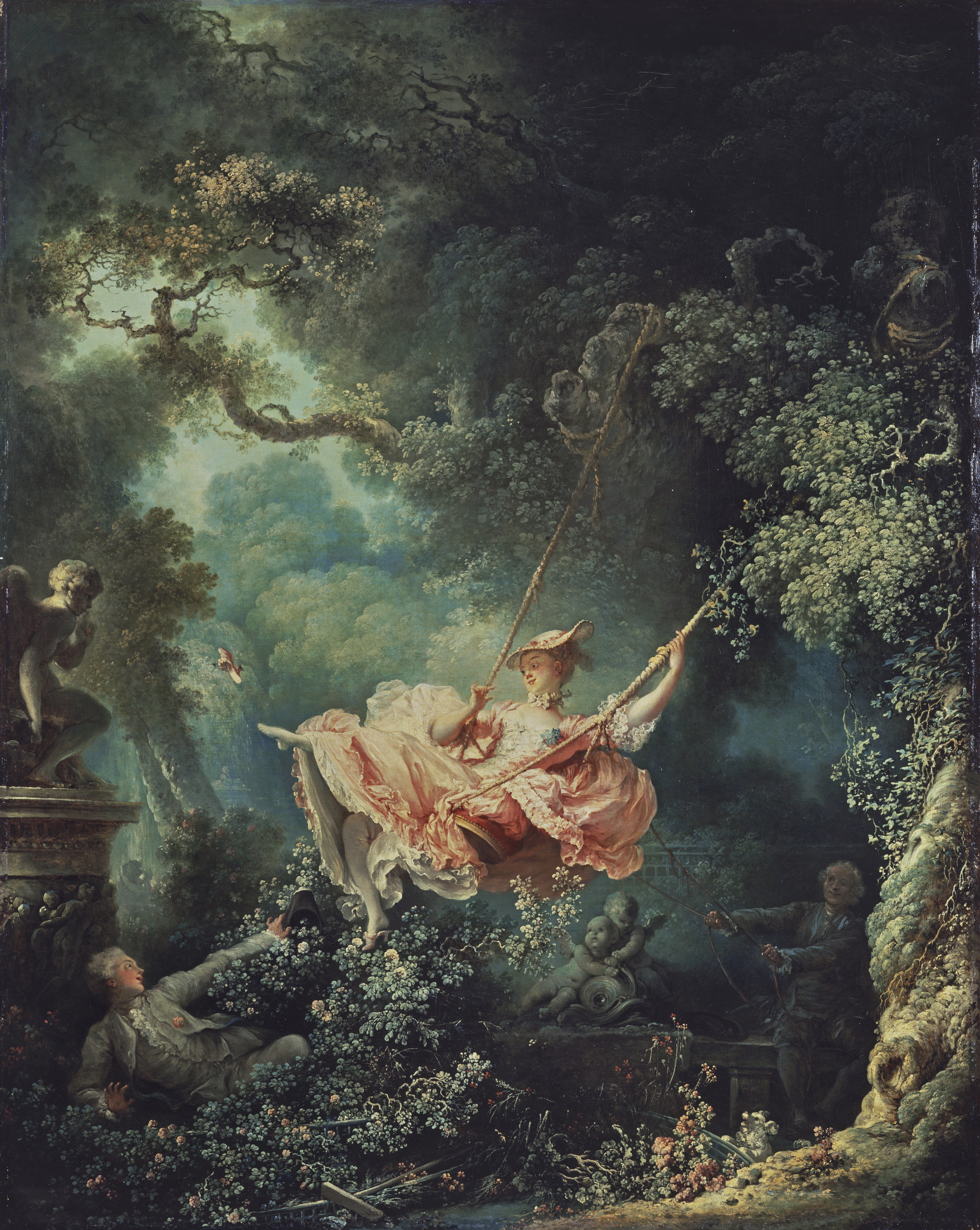
The Swing

The Swing by Jean-Honore Fragonard
1766

The Era: 
Arguably the most iconic painting of the era, The Swing by Jean-Honore Fragonard was created during a time where Rococo was a style exclusive to the aristocrats. During this time, the shift in power from the monarch to the aristocracy gave the latter more influence over the styles that dictated popular art and architecture of the past. Because the aristocracy had both immense power and wealth, the rules that governed them were more lax than that of the monarchy. Consequently, the Rococo period paintings became a celebration of a new type of culture that was loose in sexual rules and practices. 


What it Depicts:
The infamous painting's central feature is a woman on a long swing that hangs from a large tree. It appears innocent at first until you notice that she is gaily flinging off her shoe towards a suitor who lays in the bed of shrubs below her. Not only that, but her dress is flying up and she makes no attempt to smooth it down even though the male at the bottom left stares at what is beneath it. The lightness of her posture and clothing suggest a blithe attitude to anything outside of what she is currently doing. A priest stands behind her to push her forward showing that the aristocracy and their ways included those in the church as well. His position and expression imply that he is perhaps her lover.

What it Represents:
Simply put, The Swing is the embodiment of the Rococo spirit. Despite this being a "norm" for the time, the painting was still a scandal in the public's eyes. It not only captures a moment of spontaneity and frivolity, but also shows the darker side and relations of the Rococo period and its aristocrats.

Sources:
http://en.wikipedia.org/wiki/The_Swing_(painting)
http://smarthistory.khanacademy.org/rococo.html
http://www.bc.edu/bc_org/avp/cas/his/CoreArt/art/anc_frag_swing.html
http://www.artble.com/artists/jean-honore_fragonard/paintings/the_swing

Monday, November 25, 2013

"The Hunting Residence of Stupinigi"

The actualy name of the pavillion is, Palazzina di caccia of Stupinigi, which was built as a royal hunting lodge in the early 18th century in the Rococo style. It is located in Stupinigi, a suburb of the town of Nichelino,  six miles southwest of Turin.


It is one of the Residences of the Royal House of Savoy in northern Italy. The palace was designed by the architect Filippo Juvarra to be used as a hunting lodge for Victor Amadeus II, King of Sardinia. Works started in 1729 and two years later, the first formal hunt took place.


The original purpose of the hunting lodge is symbolized by the bronze stag perched at the apex of the stepped roof of its central dome. Also the numerous hounds' heads that decorate the vases on the roofline symbolize the purpose of the hunting lodge. The building has a saltire plan: four angled wings project from the oval-shaped main hall. Stupinigi was used for celebrations and dynastic weddings by members of the House of Savoy. In 1773, Maria Teresa, Princess of Savoy, married Charles Philippe, Count of Artois, brother of Louis XVI and the future Charles X of France.


Additional Sources:
http://www.ordinemauriziano.it/tesori.html
http://www.piemonteitalia.eu/en/gestoredati/dettaglio/445/beni-architettonici/550/palazzina-di-caccia-di-stupinigi.html
http://www.piemonteitalia.eu/en/eventi/dettaglio/6/cultura-e-societa/1117/stupinigi-tempo-primo-tesori-ritrovati.html
Video:
https://www.youtube.com/watch?v=7Z3fTKs-aHw

Sunday, November 24, 2013

Marie Antoinette and The Royal Chapel


Marie Antoinette married at age 14 to future French king Louis XVI. After three centuries of rivalry, France and Austria had been allies since 1756. To reinforce these diplomatic ties, Louis XV and the Empress Maria Theresa decided to wed their respective children: the Duc de Berry, Dauphin of France, aged 15, and Marie-Antoinette, Archduchess of Austria, aged 14. The festivities commenced on 16-17 May in Versailles.

The idea of a marriage between the two crowns came to fruition only in 1770. On 19 April a wedding by procuration between the Dauphin, grandson of Louis XV, and Marie-Antoinette, youngest daughter of Maria Theresa was held in Vienna. The young Archduchess arrived in Versailles on 16 May. After entering the grounds of the Château through the ornamental gates around 10 am, she was installed in the grand apartment of the queen where she prepared for the official wedding in the royal chapel. At 1 pm she made her entry into the king’s study. The Dauphin, dressed in a suit of gold with the diamond of the Holy Spirit, took her hand.

Followed by the king and the princes of royal blood, the young couple crossed the grand apartment packed with people. In the chapel they knelt in front of the altar where the Archbishop of Reims officiated. The king and the royal family surrounded them on their prie-dieus. The dauphin placed the ring on the slender finger of his bride. After the ceremony came the signing of the marriage registry. In his apartment in the early afternoon, the Dauphine received her wedding presents from the groom: a splendid carved chest containing a profusion of jewellery and precious objects.


"The young couple then attended the reception of the ambassadors before moving to the illuminated Hall of Mirrors looking out over the gardens, but the fireworks display was postponed because a storm broke out. The day ended with a sumptuous celebration in the brand new royal opera house designed by Gabriel. Then came the ritual of the ceremony of the going-to-bed: the young couple was then led into the nuptial bedchamber of Marie-Antoinette. The bed was blessed by the Archbishop of Reims. The king gave his nightshirt to the Dauphin and the Duchess of Chartres gave hers to the Dauphine. They went to bed in the presence of all the Court to show that they were sharing the same bed. Before closing the curtains, Louis XV gave some advice to his grandson. A waste of time! The marriage was not consummated until 7 years later."


After the outbreak of the French Revolution in 1789, the royal family was forced to live under the supervision of revolutionary authorities. In 1793, the king was executed; then, Marie Antoinette was arrested and tried for trumped-up crimes against the French republic. She was convicted and sent to the guillotine on October 16, 1793.

Sources:
http://www.pbs.org/marieantoinette/life/chapel.html
http://www.versailles3d.com/en/discover-the-3d-scale-models/
http://en.chateauversailles.fr/history/versailles-during-the-centuries/living-at-the-court/wedding-of-the-dauphin-louis-and-marie-antoinette
http://www.history.com/topics/marie-antoinette
http://www.versailles3d.com/en/over-the-centuries/xviiie/1710.html