Monday, February 4, 2013

Vuillard and patterns

"Interior, Mother and Sister of the Artist", Edouard Vuillard
The use of pattern in Vuillard's painting shows the influence of industrially manufactured textiles on modern life. The patterns create a confusing composition in which the sister seems to blend into the wall. This element closely resembles the work of Gustave Klimt.


"The Sunflower", Gustav Klimt
Klimt painted this work in 1909, only 16 years after Vuillard painted "Interior, Mother and Sister of the Artist". Both use a speckled background and a main subject that seems to blend into the background.


"Adele Bloch-Bauer I", Gustave Klimt
"Adele Bloch-Bauer I" resembles Vuillard's piece in the way that the figures clothing blends into the background.


Artists have begun to use patterns to their art again. Interestingly, they tend to use wall paper patterns. I think this is to comment on domesticity and suburban living, but the style most definitely comes from the early artists such as Vuillard. Below is an example of such works.


If interested, one can find more of this artist's work here.
Another very interesting example of use of wallpaper design may be found here.


Armory Show Digital Exhibition

Armory Show Digital Exhibition

Nude Against The Light by Pierre Bonnard (1908)

READ FIRST FOR BETTER UNDERSTANDING:
Pierre Bonnard's "Nude Against the Light" has another title some places (ONLINE), and it is called "Model in Backlight".


This powerful painting simply speaks for itself, but I will elaborate on the functions that is relevant behind the idea of the piece and historical era, as well.


Pierre Bonnard was a post-impressionist artist that admired Paul Gauguin's work a lot. He joined the newly formed group at the time called Les Nabis, which means "The prophets". "The prophets" had the purpose to continue Paul Gaughin's idiom which is syntetism.

Syntetism is artform where the shape and colors are simplified on a canvas to perceive a greater expression. Here is an example:

*1

Back to Bonnard, I feel like he used very strong and intensely vibrant colors, which repealed the traditional spatial cues and melted subjects together in a glowing, color saturated, ornamental synthesis.

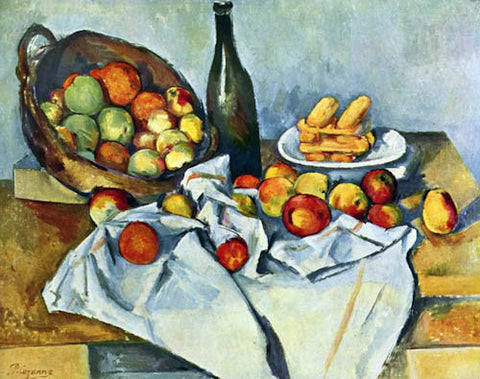
Despite the fact that I was told that this painting has no relevant research saying that it was painted at different time, I believe it was. Just like this painting called " Still life with basket of apples" by Paul Cezanne (1895)


In Cezanne's work, we can easily see how the lighting is swifting and the table frame is not absolutely rectangular or squared for that sake.

In relation to Bonnard's "Nude against the light", I have a couple of points that could possible prove it.
1. The model's breast is reflected as covered in the mirror, whereas in the picture, one breast is visible for the viewer.
2. the little bathtub in the bottom left has a little water in it, and it is reflected with a 45 degree angle instead og a straight persepective.
3. How far away in the back can that chair be located, or was he sitting on that chair to paint but decided not to include himself?


But then again, this painting really has some colors that can not be seperated. Everything is interactive and connected with brightness. The brightness of the painting plays such a crucial rule.

The most amazing thing about the painting is how Bonnard can scatter the window out, but yet make the room so bright. I am very amazed by that.

Charles Garnier, L'Opéra


When this specific building was constructed (from 1861 to 1874) it sparked Beaux-Arts historicism (or Baroque Revival) because it connected to human senses. The interesting thing about the ariel view of this building is not the opera house itself, but the roads. 


Notice how wide the roads are. At first glance we think "okay...this is pretty typical, what's the big deal?" The use of wide roads in this area time period was actually quite innovative. This allowed for opening up of population as well as facilitated transportation. The key factor, however, is that it allows for more governmental control. 

In my first blog, I wrote about "Liberty Leading the People." If people were to rebel now like they did during the French Revolution, the French Government could squash the rebelling French citizens. As soon as professor Caffey told us interesting bit of information, I thought of one of my favorite movies "V for Vendetta." Though the movie takes place in England instead of France, I thought about the wide roads and how easily the government could have contained the people had they not been saved by the masked Vigilante "V." 


Gustave Caillebotte- The Floor Scrapers


In his painting The Floor Scrapers Gustave Caillebotte bases the entire painting on light and how it reflects off of objects. He uses the same technique in his painting Paris: A Rainy Day. In The Floor Scrapers, Caillebotte uses hidden meanings to show how the artist involved in the impressionist movement are changing the art world. This metaphorical meaning conveyed through his painting was those artists are beginning to strip away the old standards of art, such as the old standards of academic standards. The artists were beginning to take over and call their own shots instead of the critics. One example of artist beginning to take control over their art was the case where James Whistler sued John Ruskin, a renowned critic over what he said about his painting and Whistler won.
The Floor Scrapers
Paris: A Rainy Day

Another work of Caillebotte was Oarsmen Rowing on the Yerres. This work was another one of his works that was included in his impressionist movement. In this work the viewer is placed in the bow of the boat and one of the oarsmen has his head down smoking a pipe as though he is not concerned with where he is going or who is in front of him. The other oarsman is casually glancing to the side as though it doesn't matter to him either. Caillebotte puts both of these men at ease while they are rowing, as though they don’t have a care in the world.
Oarsmen Rowing on the Yerres

Sunday, February 3, 2013

Observations on The Courtesan

The Courtesan Link

Vision After the Sermon


Vision After the Sermon exhibits Gauguin's departure from Impressionism and plunge into the post-impressionist world. Painted in Brittany, France, this piece illustrates the Old Testament story of Jacob wrestling the angel, which is said to represent humanity's struggle with faith. In the foreground Breton women dressed in their traditional garb, black dresses and white bonnets, watch the skirmish between the two figures. As the title suggests, the painting portrays the women's experience after hearing a sermon, suggesting that the message may have been controversial. Gauguin uses bold, primary colors to paint his composition, playing with the idea of color theory and contrasts. He experiments with a technique called cloissonism, an effect that resembles stained glass or enamel objects.Gauguin also employs inspiration from Japanese woodblock prints, a slightly tilted down perspective that symbolizes the transient, "floating world". Breaking from the banal landscapes and cityscapes typical of impressionist artists, Paul Gauguin sought to portray religious scenes in a contemporary way. His use of solid fields of color separated by thin contours is a truly unique interpretation of impressionist ideals. Something the artist received major backlash for was the strange composition of the painting. An abstract tree trunk virtually cuts the image in half, separating the Bretons from  Jacob and the angel, dividing the dream from reality.